
Insights › Strain development
Strain development
How non-GMO strain improvement works
Most of the performance gap between a wild microalga and a commercially useful one is closed by selection and adaptation. Here is what that work involves, and why we do it this way.
PhycoFerm · 11 August 2026 · 7 minute read
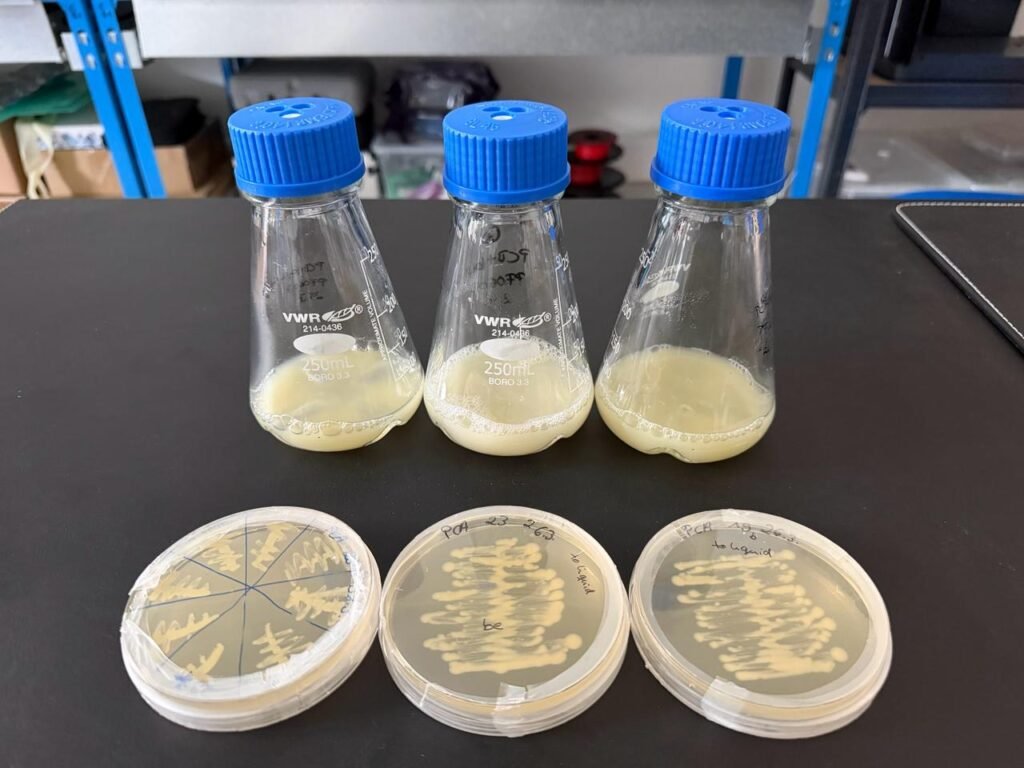
Strain isolates on plates and cultures in shake flasks. Most improvement work starts here, at a scale where you can screen hundreds of candidates.
The problem with wild-type strains
A microalga isolated from the environment is optimised for surviving in that environment. It is not optimised for producing 45% protein in a stirred tank on a defined medium at 30 °C. Those are different problems, and a wild-type strain is usually mediocre at the second one: growth is slow, the target compound sits at a low percentage of dry weight, and the cell may not tolerate the shear, the osmotic pressure or the substrate concentration that industrial production involves.
Strain improvement is the work of closing that gap. Done properly it is one of the largest levers on the cost of algal biomass, because it multiplies through everything downstream: a strain that grows 30% faster and carries 20% more of the target compound changes the economics of the whole process without any new equipment.
Four routes, and why we use three of them
Selection
The simplest and most underrated approach. You screen a population, isolate the individuals that perform best against your criterion, grow them up, and repeat. The variation you are exploiting already exists in the population. Selection is slow but it is cumulative, and it produces strains with no regulatory baggage whatsoever.
Adaptation, sometimes called adaptive laboratory evolution
Here you apply the selection pressure you actually care about and let the population adapt to it over many generations. Want a strain that tolerates a higher substrate concentration? Culture it at gradually increasing concentrations. Want faster growth at 32 °C? Run it at 32 °C for a few hundred generations and keep the fastest growers.
This is powerful because the selection pressure is identical to the production condition, so the result carries straight into the process.
Random mutagenesis
Random mutagenesis widens the natural variation before selection starts. It changes the organism’s own DNA and inserts no foreign genes. Combined with adaptation, it is how most of our colour and productivity variants were obtained.
Genetic modification
Recombinant approaches are faster for some targets. We work non-recombinant for two commercial reasons. First, EU labelling: a GMO-derived food ingredient carries an obligation that most of our customers do not want on their pack. Second, the route to market: non-recombinant strains of species already consumed in the EU avoid the novel food process entirely, which can otherwise add years.
Non-GMO is a market access decision. It buys clean label and a shorter regulatory path.
What a strain improvement programme actually looks like
The shape is consistent regardless of the target:
- Define the specification first. Not “better”, but “protein above 45% of dry weight at a productivity above X g/L/day, in a medium costing under Y per kilogram of biomass”. Vague targets produce vague strains.
- Widen the variation. Random mutagenesis, or simply a larger starting population, so there is something to select from.
- Screen at the right scale. Plates and microtitre for throughput, shake flasks for confirmation. The screen has to correlate with tank performance or you will select for the wrong thing.
- Confirm in a bioreactor. Many candidates that look excellent in a flask disappoint under real shear and dissolved oxygen conditions. This is where most of the attrition happens.
- Stabilise and bank. An improved strain that drifts back over twenty generations is not a product. Master cell bank, characterisation, and a stability study.
The trap: improving one number and breaking another
Protein content and growth rate frequently trade off against each other. So do pigment content and productivity. A strain selected purely for the highest protein percentage may grow so slowly that the cost per kilogram of protein goes up rather than down.
This is why we develop the strain and its process together. The right question is never “what is the highest protein content we can reach”, it is “what combination of strain and process gives the lowest cost per kilogram of protein delivered to specification”. Those are different optimisations and they have different answers.
Where this leaves a company that needs a strain
Three practical options. Licence a strain and process that already exist, which is fastest where one fits. Have a strain developed against your specification, which takes longer but gives you exactly what you need and, in our case, full ownership of the result. Or improve a strain you already hold, which is often the cheapest route and is more common than people expect.
Whichever it is, start from the organism rather than the compound. The species sets the ceiling on what is achievable and the regulatory path you will be walking. Everything else is negotiable.
Have a strain, or need one?
We improve non-GMO microalgae strains against a defined specification, including strains you already hold. Fixed fee, fixed timeline, and you own the result.
More from our insights
Why growing algae in the dark changes the cost.