
Insights › Ingredients
Ingredients
Algae exopolysaccharides: what EPS is and why cosmetic formulators want it
Some microalgae secrete a polysaccharide matrix into the water around them. Extracted, that matrix behaves in a way that skin care formulators find hard to reproduce synthetically.
PhycoFerm · 11 August 2026 · 6 minute read
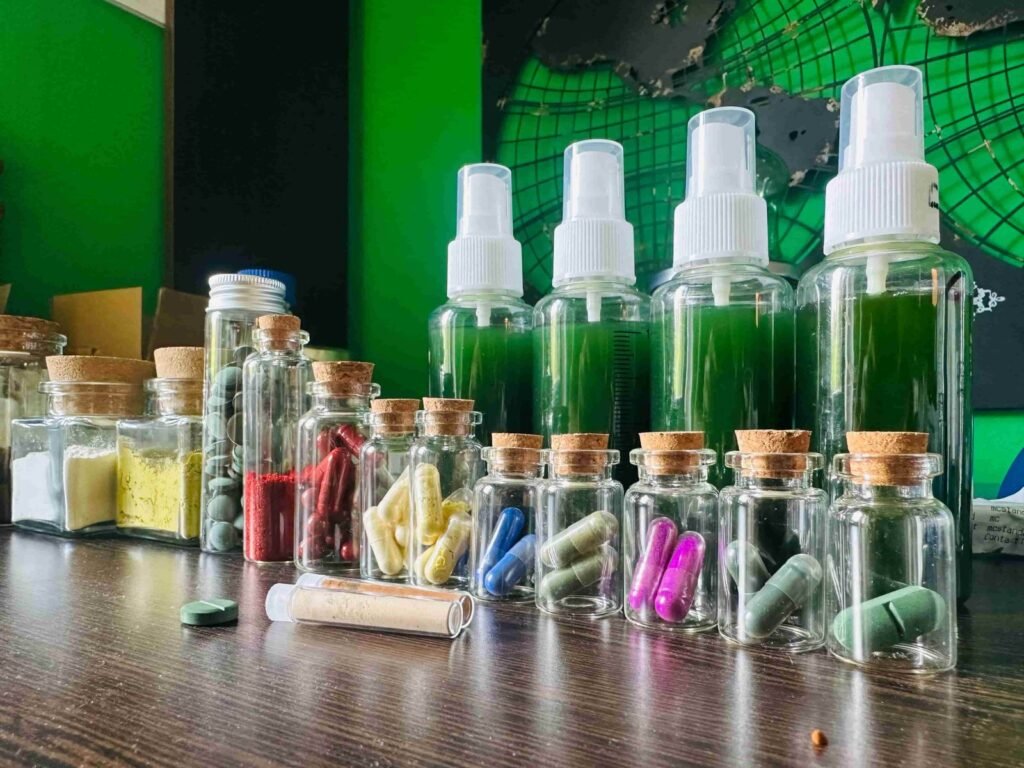
EPS is supplied as a liquid for cosmetic formulation.
What EPS actually is
Exopolysaccharides, usually shortened to EPS, are high molecular weight carbohydrate polymers that a cell secretes outside itself. Many microorganisms make them. In microalgae they form part of the mucilage that surrounds the cell, and they are thought to serve several functions at once: retaining water, buffering against osmotic shock, binding metal ions, and acting as a physical barrier.
The commercially interesting ones are sulphated. In Porphyridium purpureum, a red microalga, the secreted polysaccharide carries sulphate groups along the polymer chain. That sulphation is not a detail. It is what gives the molecule its charge density, its water-binding behaviour and much of its biological activity, and it is unusual outside marine organisms.
Sulphation is the reason algal EPS behaves differently from a plant gum. It is a charged polymer, not just a thickener.
Why cosmetic formulators are interested
Three properties, and they tend to arrive together:
Water binding and film formation
A charged, high molecular weight polymer holds a great deal of water and forms a continuous film as it dries. On skin that reads as immediate smoothing and a reduction in transepidermal water loss. Formulators get a sensory effect and a measurable barrier effect from the same ingredient, which is unusual.
Rheology at low inclusion
EPS modifies viscosity and gives a distinctive slip at inclusion levels well below those needed for conventional gums. That matters in a serum or a light emulsion where you cannot afford the weight a carbomer or a xanthan would add.
Reported biological activity
Sulphated algal polysaccharides have been studied for antioxidant, soothing and anti-inflammatory effects, and in some cases for effects on matrix metalloproteinase activity. Two caveats. The published work varies in quality, and activity depends strongly on the specific polymer, its molecular weight distribution and its degree of sulphation, which means a result obtained on one organism’s EPS does not transfer to another’s. Any claim you intend to make needs substantiation on the actual material you are using.
Why it is difficult to produce
EPS is secreted into the medium, which sounds convenient and is actually the problem. You end up with a very dilute, very viscous broth. The viscosity rises as the culture becomes more productive, which restricts mixing and gas transfer in the vessel, so the process fights itself: the more successfully it works, the harder it becomes to run.
Recovery is the second difficulty. Separating a high molecular weight polymer from a dilute aqueous medium without shearing it into fragments takes care, and shear degradation shows up directly as lost performance, because the molecular weight is doing much of the work.
Porphyridium is also a red microalga with a photoautotrophic lifestyle, which means light management rather than fermentation is the central process question for this particular product. It sits in our portfolio because we run light-driven processes alongside fermentation.
What a formulator should ask a supplier
- Which organism, and is it named? “Algae extract” is not an answer. The species determines the polymer.
- Is it sulphated, and to what degree? This is the property most closely tied to activity.
- What is the molecular weight distribution, and how reproducible is it? Shear history during recovery shows up here.
- What format, and at what solids? Liquid and powder behave differently and are not interchangeable in a formulation.
- What is the regulatory position for my application? Cosmetic and food are different assessments and one does not imply the other.
Where ours sits
We supply sulphated exopolysaccharides from Porphyridium purpureum as a liquid, for cosmetic formulation. Composition data comes with the sample and the figures for the material you receive come on its certificate of analysis. It is supplied for cosmetic use, with its own regulatory position.
If you are formulating and want to see how it behaves in your system, the fastest route is 50 mL and a fortnight on the bench.
Request an EPS sample
50 mL of sulphated exopolysaccharides from Porphyridium purpureum, with composition data and a certificate of analysis.
More from our insights
Why growing algae in the dark changes the cost.